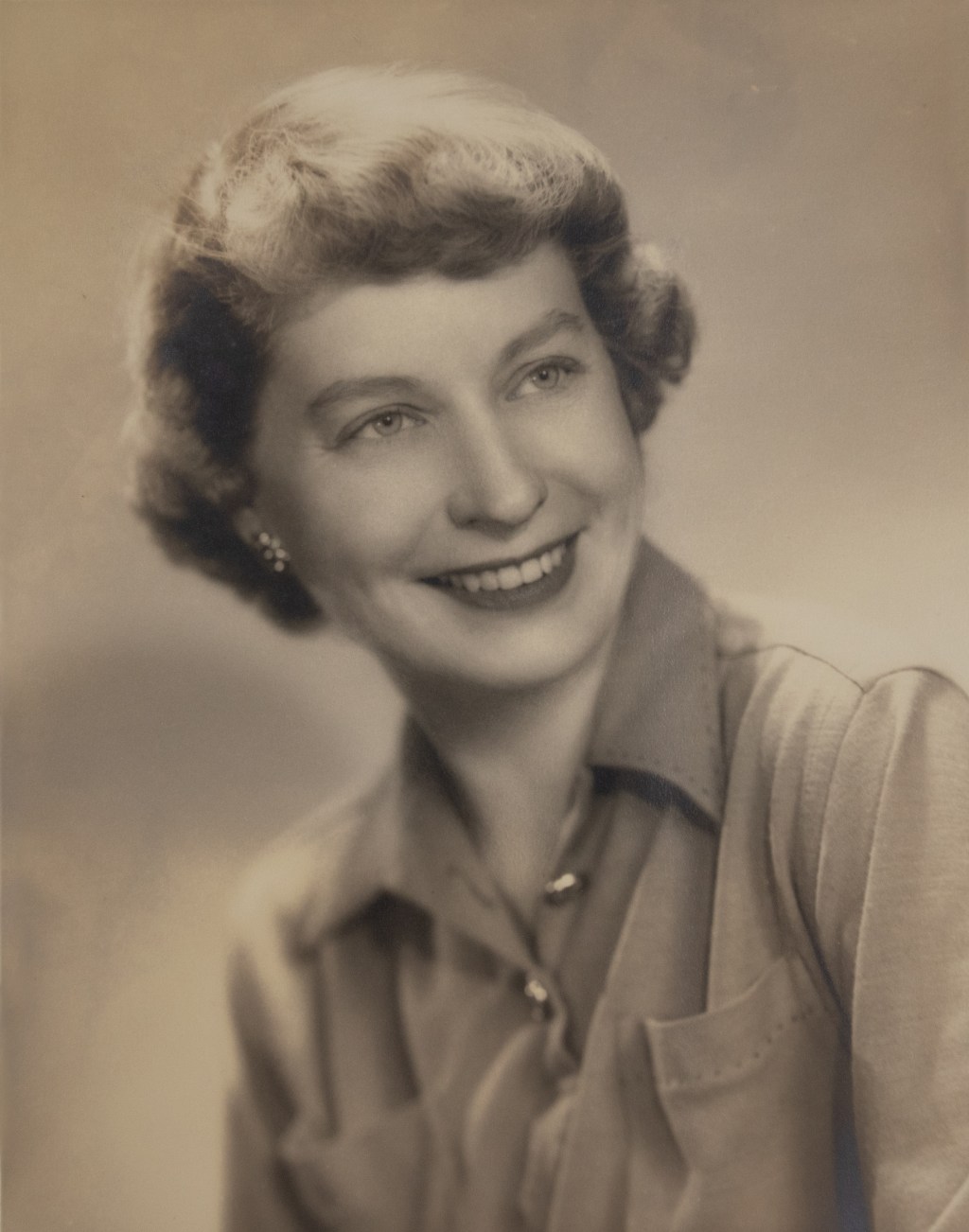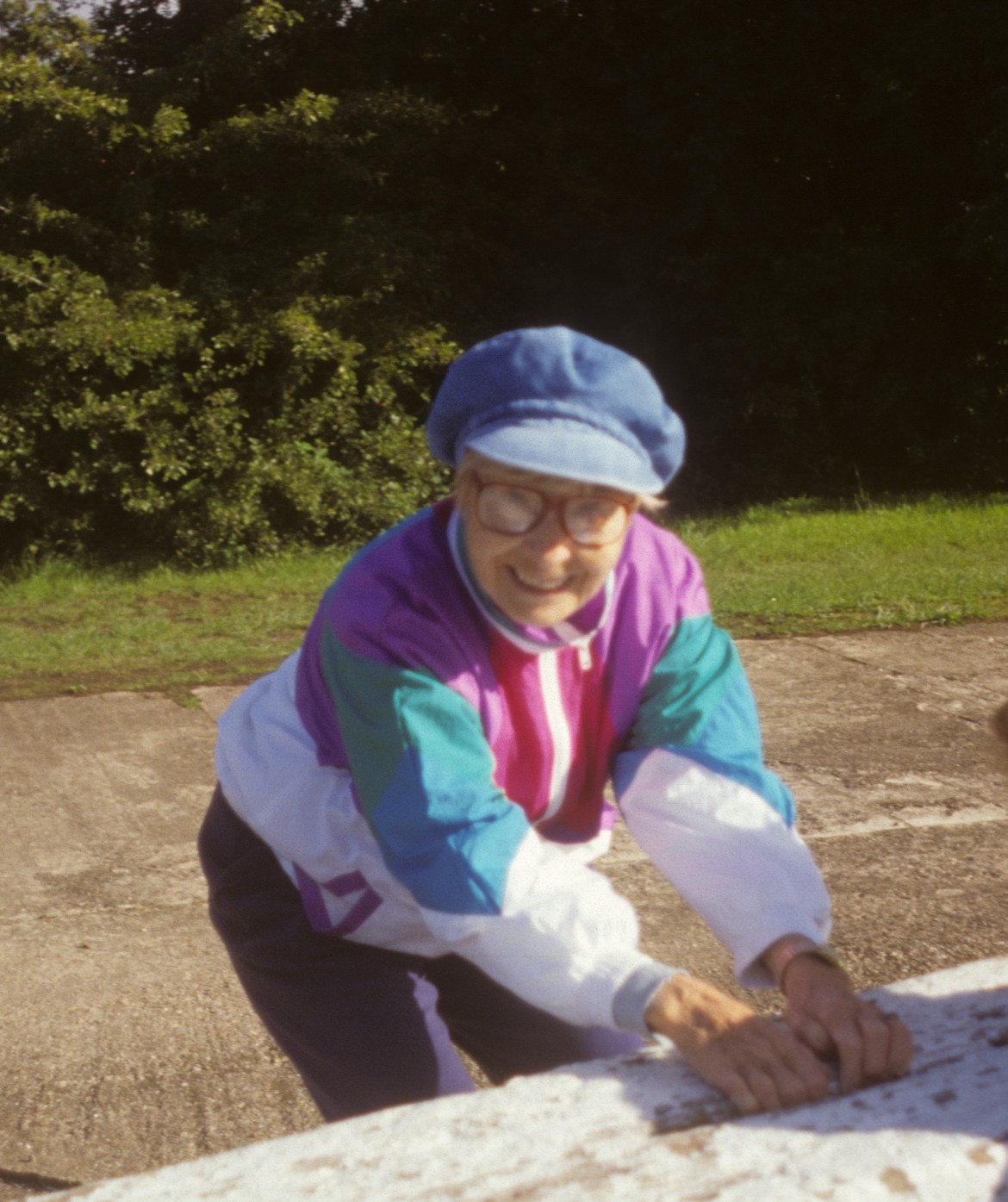
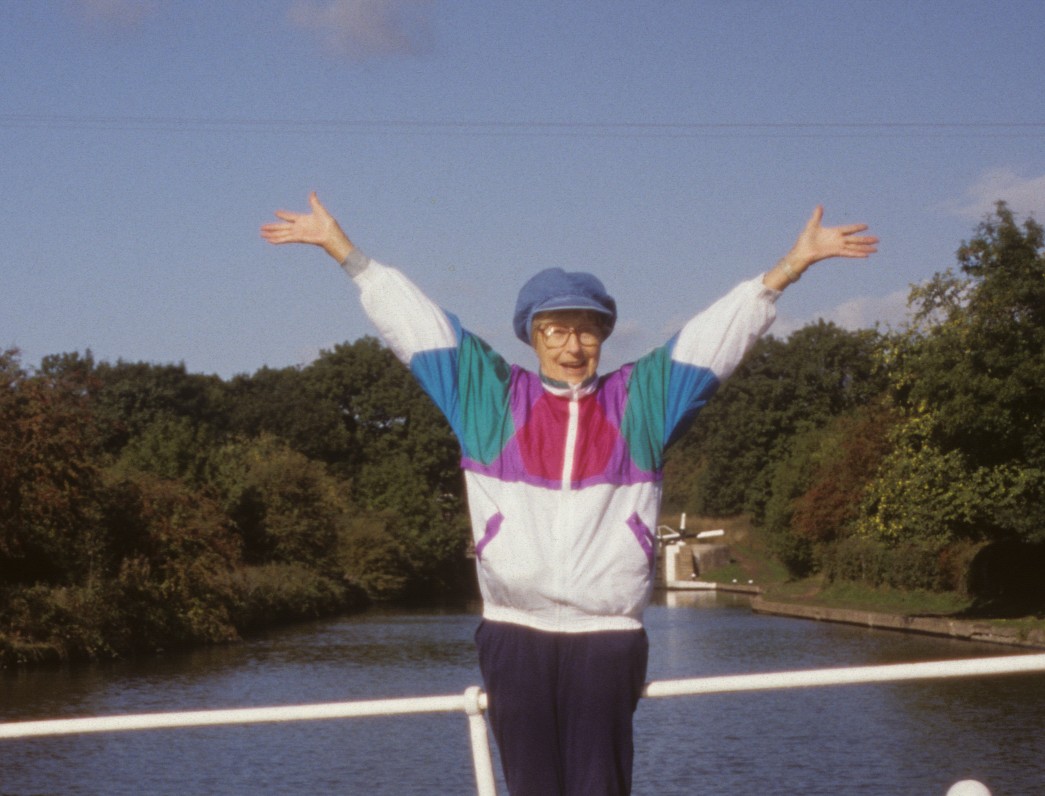
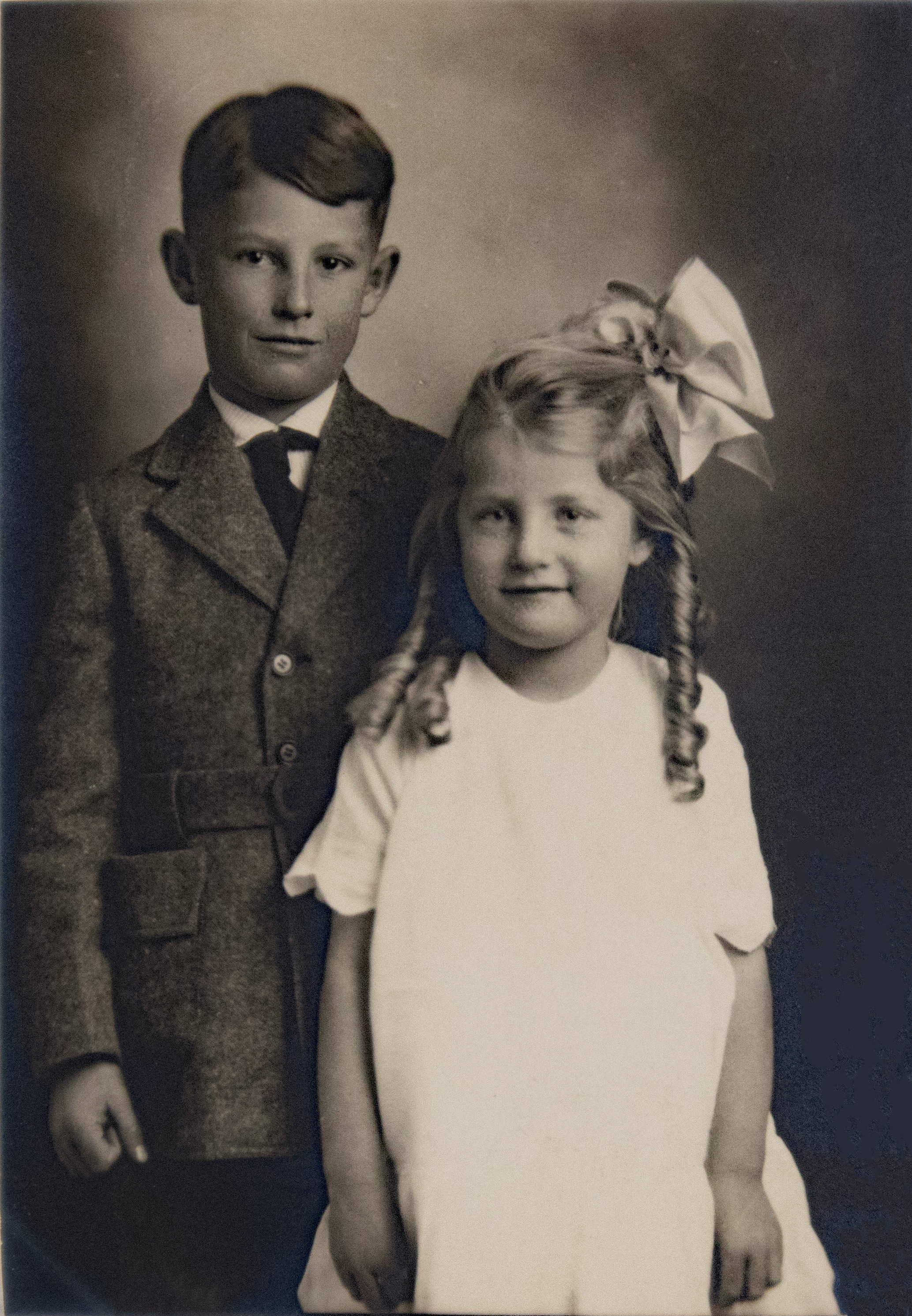
Kirby Brock
This biography was taken from various sources including letters from Kirby Brock. The earlier parts of her ancestry were taken from her mothers letters and book. They both had distinctive voices in their writing and the editors of this biography have tried to maintain those voices in the following article.
It’s well understood that any good biography needs to start well before its subject appears on the scene, so here we’ll start with Kirby’s Scottish paternal grandfather, John Sanderson Dalziel (b. Dec. 24, 1838), who was probably Kirby’s earliest artistic influence after her mother. John S. was a nephew of the proprietors of the famous Dalziel Brothers wood engraving and publishing firm, had apprenticed under his uncles from age 13, and became one of the shop’s best engravers.
While still in Great Britain, he married Jane Elisabeth Deykes (b. Feb. 6, 1840) of London, on Oct. 8, 1861, and there they had five daughters. However, that life came to a screeching halt when reliable photoengraving arrived on the scene, promptly eliminating Great Britain’s entire wood engraving industry. John responded by emigrating to the USA, where photoengraving had yet to appear, arriving in New York City in Nov, 1869, aboard the mail steamerCity of Antwerp. He found engraving work immediately, but “disliking the smell of New York,” soon moved to Montreal, Canada. In 1871 he moved to Germantown, PA, and brought his wife and children across the Atlantic, where-after they had three more children, the last of which (and only boy) was John Gamaliel Dalziel, (b. Sept. 4, 1882), who would in due time become Kirby’s father.
“Progress” rolls on, and when his beloved line of work ended in the USA too, John S. and Jane, with the younger children, moved out to Cañon City, Colorado in 1890, and became a fruit farmers, learning the trade from a textbook. But the fruit industry there, which had boomed during a lengthy mild spell, failed when the climate returned to normal, and in 1895 they moved again to farming territory near Longmont, Colorado. There they stayed until moving to Denver, CO, in 1915.
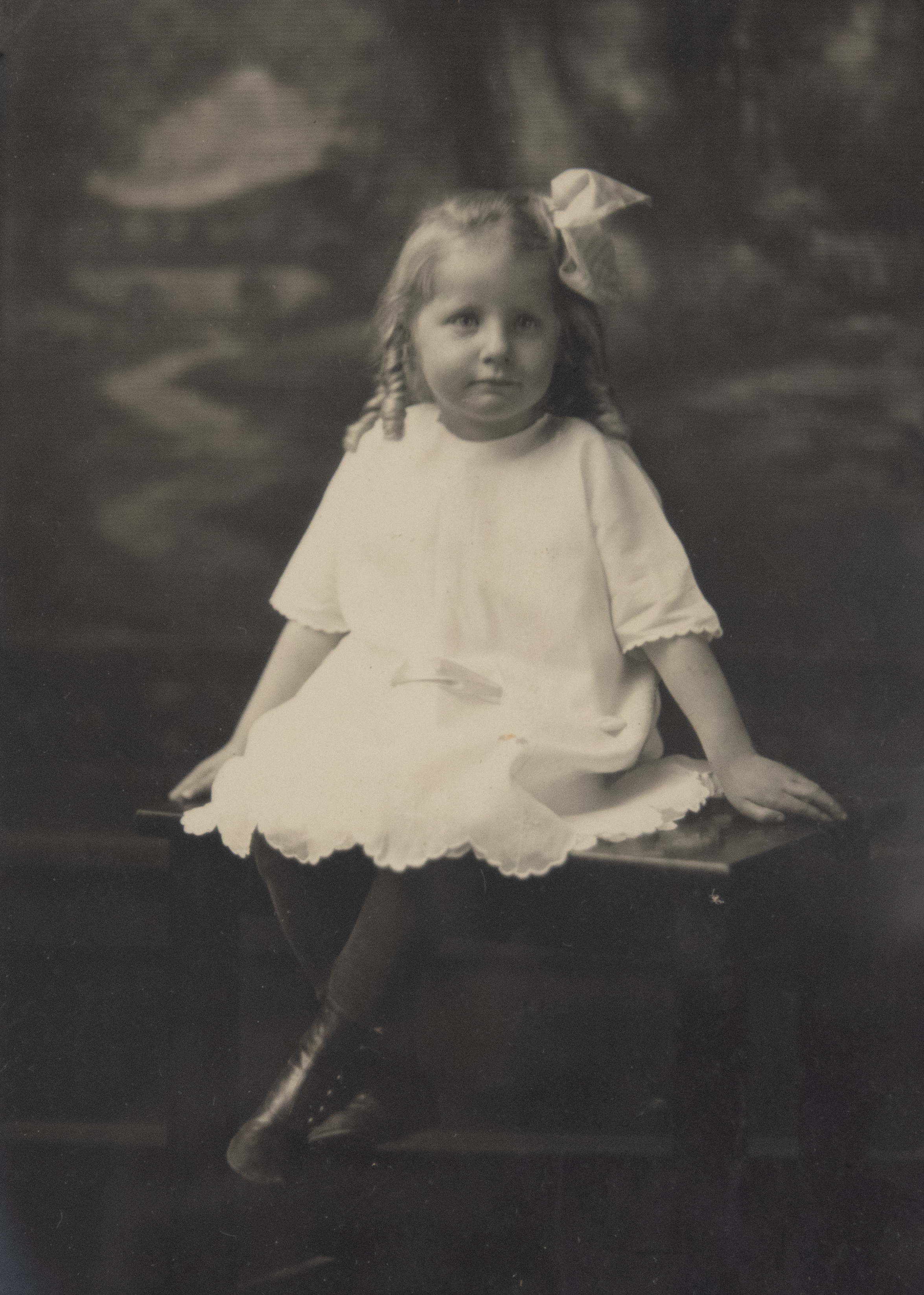
It was during this stay in Longmont, on Oct. 22, 1912, that John G. married Hazel Florence Webb (b. May 26, 1890). The couple lived in Ft. Collins, Colorado, where John G. had secured good work as manager of a grain elevator for Model Mills. There also their children were born. Their third and final child, born Feb. 15, 1917, was Kirby Jane Dalziel, named after her maternal grandmother’s surname and her paternal grandmother.
Most of what is known about Hazel’s parents comes from her 1988 book, “Joyful Childhood Memories of a Pioneer Woman (Some not so joyful).” The pioneer woman in question is her mother, Mildred (Millie) Ann Webb (nee Kerby) (b. Dec 5, 1848). At the time of the Civil War, The Kerby family, solid Missouri farmers, found themselves on the dividing line between the Union and Confederate armies. Sometime after the war ended, Millie Kerby moved west to Longmont, Colorado.
Millie, showing symptoms of “consumption,” meaning tuberculosis, arrived in Colorado in search of health in the much drier environment- at that time, a fairly common reason to migrate to Colorado. An aunt, Sue Sumpter (nee Pearcy), was already living in Longmont when Millie arrived, and cared for her until she was feeling better. Hazel also mentions Millie’s cousin Ella being present in the early 1890‘s.
Hazel’s father was Charles Benjamin Webb (b. April 27, 1845). From Hazel:
“All we knew about the early life of our father came from his sister, whom we called “Auntie.” He was born in Maine on April 27, 1845. His father was a preacher whose family had moved into Maine at the end of the Revolutionary War. The house in Maine had seven rooms. The house, sheds and barns were built around an enclosed yard making it easier to take care of themselves and the animals during the long winters with their deep snows.
“When Father was grown, his older brother inherited the family home. Auntie (named Myra) and Father went to Chicago. Sometime later, they joined the Chicago Colony [ https://coloradoencyclopedia.org/article/chicago-colorado-colony ] and came to Erie, Colo, on the train.
“Auntie, who was a widow with two sons, had some means and bought property in Longmont. She opened a rooming house on the corner of Fourth and Kimbark. …
“Father took a tree claim six miles east and two north of Longmont. He set out 10 acres of ash trees which are hard and straight and useful for many things around the farm.”
Charles Benjamin and Millie Ann met at a social in 1880, and married on Feb 10, 1881. Nine years later, Hazel, sixth of eight children, was born on that farm. Hazel was an active and enterprising child, selling milk, eggs, and other farm products door to door in town, earning the family some much appreciated money. This was rather to the consternation of her siblings, who would complain that there weren’t any eggs, or that “Hazel sold all the milk!”
As was normal for small-town and farm life in the late 1800‘s, local people created their own activities and entertainments, and the Webbs were fully engaged. Hazel writes of frequent social events held at the farm, and later when they moved into Longmont in 1900. Hazel played piano and organ, was a skilled singer, and attended regular music lessons in town. Highly unusual for those days, Hazel earned a bachelors degree in music from Colorado State University in 1930, at age 40, when Kirby was 13. At some point she became a good amateur painter. She also developed an encyclopedic knowledge of the flora of the Colorado plains and the Rocky Mountain foothills.
Less than two months after Kirby’s birth on Feb. 15, 1917, the USA entered World War One. Shortly thereafter, her father was inducted into the Army, and as a Quaker he was assigned to driving an ambulance in the French trench system. Since he had management experience, he was quickly re-appointed to the Transportation Department as a transportation manager and worked extensively with the 1st Army Region YMCA. He mustered out and returned home in the spring of 1919, when Kirby was two years old.
Kirby was a gregarious child who liked being around other people, and took a genuine interest in what they were doing. This was a trait that served her well her entire life. There was continual artistic activity in the home, along with regular visits to grandparents in Denver, where Kirby would have been surrounded by her grandfather’s art and the works of others he had collected. Books and reading were important, no doubt aided by copies of the many novels, classics, encyclopedias, and dictionaries that her grandfather had illustrated during his storied career.
Kirby was a “natural” student and did very well in school, and after graduation she entered the University of Colorado in autumn of 1936, joining the Kappa Kappa Gamma sorority [Beta Mu chapter]. That year, Kirby, along with Jane Ewart, both freshmen, directed the two choruses for the campus rhythm circus. It’s unknown if this was with advice and help from Hazel, but I suspect so, and Hazel was a determined organizer.
On June 7, 1940, shortly after graduating with a Bachelor of Arts degree, Kirby married Charles Linden Brock (b. Nov 6, 1916), whose father, Elmer Leslie Brock (b. Dec 15, 1880), was a prominent Denver, CO, attorney. Kirby’s brother Jack and Charlie were Chi Psi fraternity brothers, and they knew each other before Kirby and Charlie met.
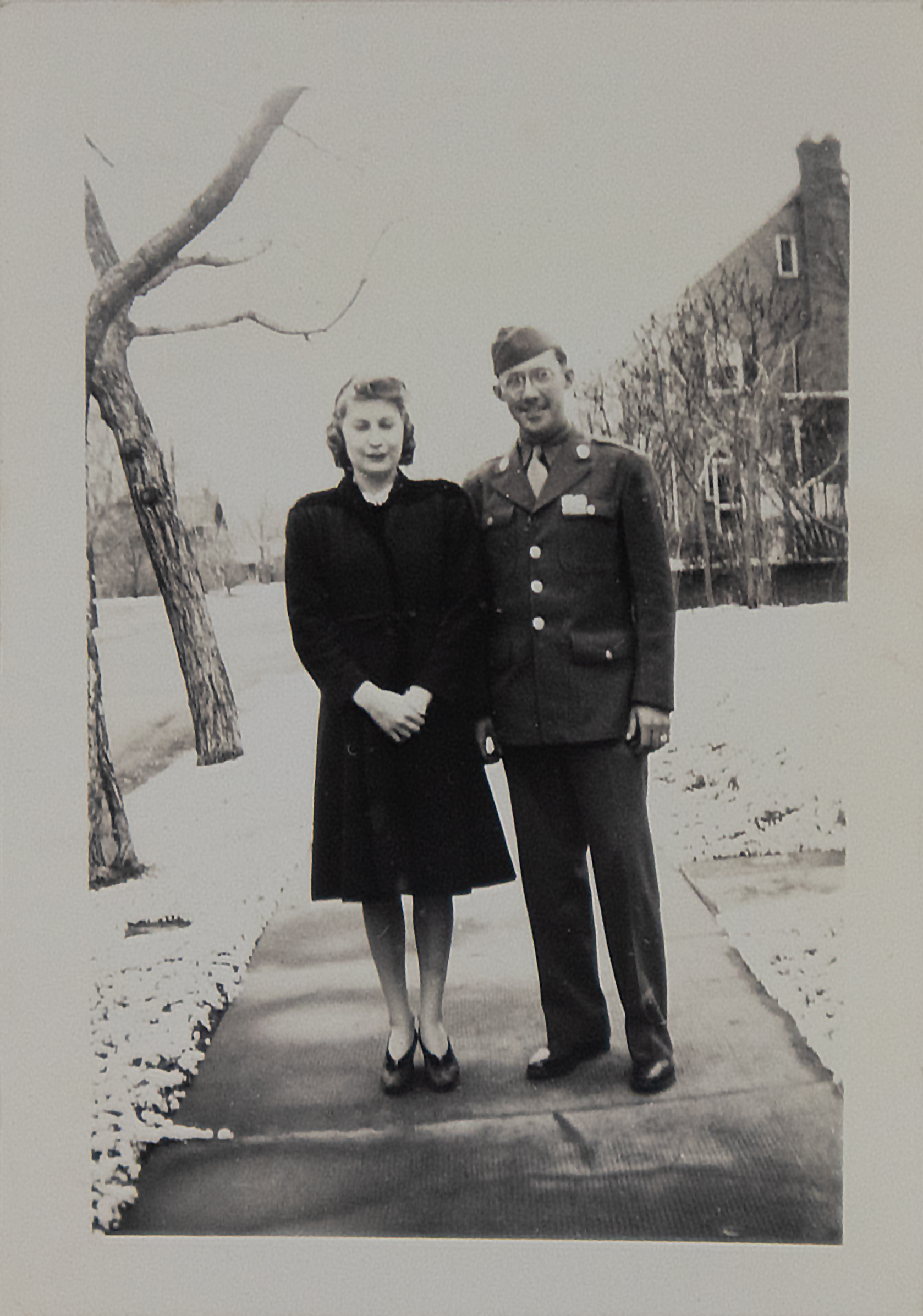
Kirby’s life was much altered by both world wars. In 1941, the United States entered WW2, and like her father in WW1, husband Charlie shipped off to war. He was shot in the head by a nazi soldier, sent home as not expected to survive; however, he pulled through but with serious mobility problems. After a long recovery, he was able to walk and speak in a disjointed fashion, but his intellectual abilities were undamaged.
Most of Kirby’s post-war time for several years was spent taking care of Charlie. They lived in the Brock family home in Denver (1410 E, 4th Ave, Denver, CO), but his was not optimal as there were two stories plus a basement, and as Charlie could not climb stairs, he could only use the ground floor.
This was also a period of a lot of death in the family. Kirby’s grandfather Charles Webb died in 1943, grandmother Jane Dalziel died in 1946 (at age 106), father John G. Dalziel in 1948, and both grandmother Millie Webb and Charles’ father Elmer Brock in 1949. Needless to say, this was not a pleasant part of Kirby’s life.
But perhaps this is a good example of making lemonade when life hands you lemons? As Kirby told the story years later, “After the war Charlie and I were feeling pretty sorry for ourselves, and we began drinking too much. Somebody gave me a pamphlet from Alcoholics Anonymous, and (laughing) I was sitting in my chair- with a martini in my hand- reading it and thinking ‘This would be great- for Charlie.’” They began attending meetings and quickly found out is was great for both of them, kicked alcohol entirely, and became contributing members of the organization. They attended meetings for many years afterwards, to help others, and incidentally meeting many of Denver’s movers and shakers.
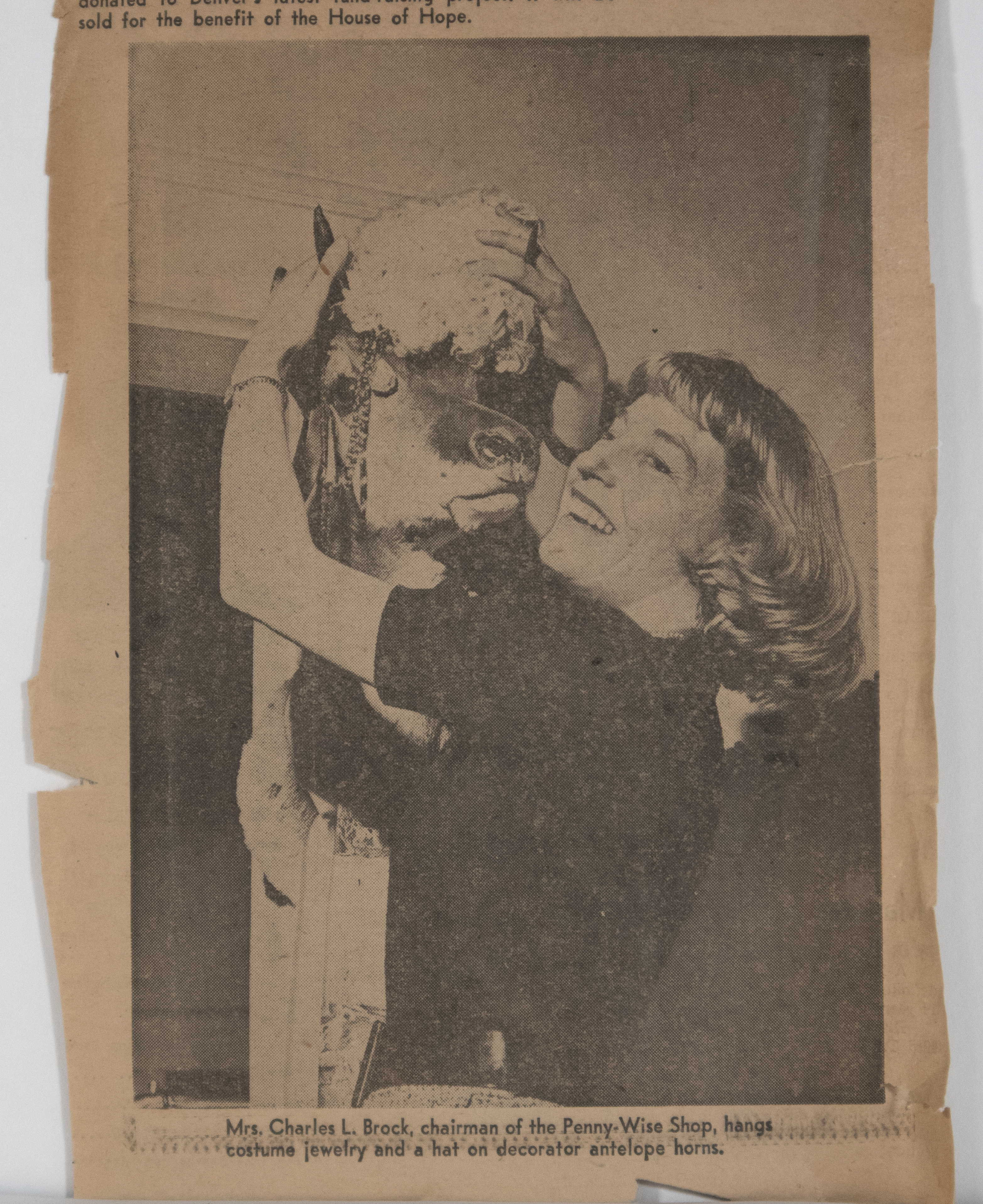
Charlie eventually recovered enough that he was able to take a job as an insurance agent, as the agency was willing to accommodate his disability. He became skilled at investing, and by 1958 they felt comfortable enough to buy their own home, join the Denver Country Club and the Junior League, and do some traveling (Kirby’s brother Jack once said that when Charlie made particularly profitable investments, they took trips).
And Kirby began to paint. She wrote: “When I was thirty (in 1947) I looked out over an open field and decided I would like to paint what I saw. I went to the drug store and bought a 35 cent box of water colors and some paper. This started an addiction which grows worse through the years.” The rest, as they say, is history. It’s impossible at this date to know how much her father’s passing in 1948 influenced her decision to embark on an artistic career, but I suspect it had an impact. Kirby once told me that her father was very much opposed to a career in the arts for any of his children. Likely, this was due to the hardships and many moves the Dalziel family faced after the end of wood engraving.
It was also somewhere during this time that Kirby and husband Charlie met playwright Mary Chase, who lived just a few blocks from the Brocks. Exactly when seems to be unknown, but it would have been after 1945 and before mid-1951 as Kirby recalls serving with Charlie as a test audience to Mary reciting the play Mrs. McThing, which was produced on Broadway in 1952.
At age 82, Kirby recounted the story to Ellen A. Wilkin, who was writing a biography of Mary Chase:
“And the way I happened to meet Mary was through a friend of mine that I went to school with in Boulder [Colorado]. She just walked over and knocked on the door and told Mary Chase that she wanted to meet her. She got to be very friendly with Mary, so she got us introduced to Mary. I forgot what the occasion was, but she got us introduced to Mary. And then because Charlie was not able to work, you see, we had time, so we would be over there in the morning listening to these plays she was writing.”
….
E. Wilkin: “Did you give her some feedback?”
Kirby: “Charlie’s feedback was laughter. If he laughed it was OK. {laughs] It would stay in if he laughed.”
….
Kirby: “I don’t know, there’s some-see, Charlie was- had- been wounded and I think Mary saw us, and, which was true, as needy, and we were, you know, because it was a hard-hard to come back from that with ah…”
E. Wilkin: “In a lot of ways.”
Kirby: “Yeah. And Charlie wasn’t able to walk right and ah, he got hit in the left side [of the head] I think, and it was the right side that didn’t work, you know.”
E. Wilkin: “Oh. OK.”
Kirby: “They worked a little bit. He kept at it until they worked, but anyway he had this wonderful Irish sense of humor. And that was, I think, the reason we stayed such good friends. That and the fact that Mary was always calling us and asking us to do some fun thing like she took us to Philadelphia and -”
E. Wilkin: “For that play.”
Kirby: “Yeah, and paid for our hotel and everything.”
Once Kirby began to take her art seriously, she essentially became a perpetual student; if there was something she wanted to know, she took pains to find out. She lists her first influential teacher as Marianne Pisko Hausmann.
Kirby: “Madame Hausmann, a delightful person taught me to observe more accurately. Then came that marvellous [Emily Griffith] Opportunity School with its grand assortment of human beings. The teachers I studied with there were: Henry [Enrique] Montenegro, [later] head of the Pennsylvania State [University] Art Dept., Rolland [Roland] Detre – [later] professor at CWC” (Colorado Women’s College, now merged with the University of Denver).
Marianne Pisko Hausmann (b. 1880, d. 1969) was born in Vienna, Austria and studied at the Academy of the Austrian Museum of Art and Industry in Vienna. With the tide of naziism rolling across Germany, and being Jewish, she left Austria for the United States, arriving in Denver in 1939, where her daughter Margaret Grieg was an ophthalmologist, and her aunt by marriage Seraphine Pisko had recently retired as the executive director of the National Jewish Hospital. Locally, Marianne was a noted artist, exhibiting regularly throughout the 1940‘s including at the Denver Art Museum.
“Henry” Montenegro is Enrique Ernesto Montenegro (b. 1917, d. 2003), from Valparaiso, Chile. Upon moving to the United States in his early twenties, he earned a Bachelor of Fine Arts degree from the University of Florida in 1944, before moving to New York to study at the Art Students League. He landed at the University of New Mexico in 1946, staying through 1952, later becoming head of the Pennsylvania State University Art Department. His work is widely viewable, including at the United States National Gallery of Art: [ https://www.nga.gov/artists/5800-enrique-e-montenegro ], the North Carolina Museum of Art: [ https://ncartmuseum.org/artist/enrique-montenegro/ ], and in Albuquerque. at The Mall. [ https://publicartarchive.org/art/The-Mall/aaef74ac ] There is also a book: Enrique Montenegro: Conversations with the Artist, by David Montenegro: https://www.amazon.com/Enrique-Montenegro-Conversations-Artist-David-ebook/dp/B008OADEC4
He had a lot of impact on Kirby and introduced her to abstract expressionism, which suited Kirby just fine and you can see the influence in many of Kirby’s paintings. For several years, she also followed his ideas about how people look at paintings, but later decided that most people, who are not artists, don’t view them that way.
Roland Detre (b. 1903, d. 2001) was born in Budapest, Hungary and studied art at the Budapest Academy before moving to Berlin in 1926, and then to Paris in 1930. He caught tuberculosis in 1936 and moved to a sanitarium in Switzerland, where he stayed until the end of World War Two. He then moved back to Paris, and in 1950 moved to New York. Very quickly he moved to Denver, Colorado, to be treated again for tuberculosis at the National Jewish Hospital, remaining in Denver afterwards. He was a prominent figure in the Denver modern art scene throughout the rest of his life.
Book by Roland Detre: Old World Recollections
Westword article on Roland Detre exhibition, Feb 7, 1996
There are two more art teachers that Kirby specifically named as influences; the first is the little-known John Loftus (b. 1921, d. 2008), from Cumberland, Maryland, who studied art at the Hans Hofmann School and at Columbia University. He exhibited widely across the United States but appears to have been in Denver only for a short while in the mid-late 1950‘s. At different times he worked in the Mulvane Museum of Art in Topeka, Kansas, and taught art at Ohio State University.
The second is the better known Akiba Emanuel (b. 1912, d. 1993). He was a New York artist who began exhibiting in 1938 and remained active in that city for some forty years. He caught the eye of Marian Willard at the East River Gallery, who was happy to promote his work. When and where he taught Kirby is unfortunately unknown, but visually, his influence is obvious.
Akiba Emanuel.com [https://akiba-emanuel.com/
Kirby also mentions lessons at the Colorado Springs Fine Arts Center, part of Colorado College. When, and with whom she studied there is currently unclear. In later years she took a number of courses at the Community College of Denver, notably classes in welding and ceramics. She repeated the ceramics class many times as the college had a good kiln and the instructor was a wizard at its operation.
Currently, it’s uncertain when Kirby began exhibiting her work, but it was probably sometime in 1949 or in early 1950‘s. Exhibits were mostly in Colorado, including at the Denver Metropolitan, the Gilpin County Exhibit, the State Fair, the U. S. Air Force Academy, Neusteters and May D & F department stores, the Jewish Community Center, and in Cañon City. She mentions three one-man shows during this period, and two exhibits with other painters. In the early 1960‘s, there were at least three exhibits of Kirby’s work at Denver Art Museum shows.
It should probably be noted that an artistic career doesn’t take place in a vacuum; Kirby and Charlie’s sorority and fraternity connections, which were more important in those days, along with the Brock extended family, plus connections to the influential Bromfield family through the marriage of Kirby’s father’s older sister Edith, plus the connections she made in A.A, the country club, the Junior League, and through her art teachers- all combined with Kirby’s charismatic personality- helped get her work into prominent art shows, and years later, when Kirby began painting portraits professionally, gave her a “ready made” flock of patrons interested in and able to afford painted portraits of family members.
Here also, Mary Chase played a prominent role, and it certainly didn’t hurt that Mary knew “everybody.” Prior to her fame as a playwright, she had been a reporter for the Rocky Mountain News for fourteen years, was their society editor for several of those, and married a fellow reporter. Mary was an early client, and Kirby painted portraits of her sons and several grandchildren. She was also important to Kirby’s professional career; from the interview by Ellen Wilkin:
Kirby: “You see, one of the things that Mary did for me-she hung that painting of [her son] Colin in her dining room, and then when people came by, she told them. That’s how I got customers.”
E. Wilkin: “Yeah.”
Kirby: “… And it was hung in the dining room. It was a big painting. I never painted anything small. Well, I-later when I did regular portraits. But I liked a big space to paint on. But, uh, that was one of the things that was very- that was a wonderful benefit to me. …”
Kirby finishes: “Of course, all of the times we were with [Mary] were wonderful for Charlie because uh, you know, I mean, it was always a laugh session. Always.”
Mary Chase and the Brocks remained close friends until Mary’s death in 1981.
Kirby’s approach to artist’s materials was entirely eclectic, and she had nothing against experiments or unusual combinations. She began with watercolors and used them all her life. Pencils, pastels, charcoal, and ink naturally followed. She soon added oil paints, and acrylics when they became available in the mid-1950‘s. She became an expert user of different styles of brushes, palette knives, sponges- and fingers.
It wasn’t unusual for her to combine watercolor washes with other media. She worked on the usual paper and canvas, but also painted on wood, plaster, brick, bowling balls, and in one case on clear plastic sheet (with acrylics, I think). She learned the secrets of ceramic glazes and experimented with different ways of applying them as opaque or translucent. Each material, each method had its hidden possibilities, and it was up to the artist to find them and put them to good use.
I don’t recall she ever seriously tried working with her grandfather’s wood engraving tools. She did try silk screening but seems to have not continued with it.
During her early career, Kirby sold a number of paintings through various exhibits, shows at local art galleries, plus a few commissions. Most of these were either still-lifes, landscapes, or abstracts. Probably at the urging of Mary Chase, Kirby began painting portraits professionally in 1970, and continued through about 1980. After this she only painted portraits for former customers and stopped taking on new clients. When I asked why, she told me that the process had become too repetitive and she was afraid of “going stale.” Her artistic interests were heading in a different direction, and she wanted to do more sculpture, more ceramics, and to paint and draw different subjects. While she continued to paint regularly, most of her work was now abstracts or landscapes.
She left behind a brilliant description of how she painted portraits, which she wrote for an article that appeared in the 1975 issue of the KKG newsletter https://wiki.kkg.org/images/a/a7/THE_KEY_VOL_92_NO_4_WINTER_1975.pdf. From the letter she wrote to author Florence Longford:
“Each person I paint, no matter how small (one was only a year and a half) seems to have in little buddings the promise of the mature person; it is this that so fascinates me. So I will tell you how it goes. I spend an hour or so in the person’s surroundings- sometimes sketching, sometimes taking photographs- trying to soak up a feeling (aura?). I’m sure I could save myself a lot of agony if I could then figure out just the right pose, lack of pose style, etc, but the painting has got to take me on too, with all my assets and liabilities. I am a jumper in the middle- flaying away in all directions.
“So the sitter comes to my house where I have a studio (loaded with junk; whatever we can’t find a place for, goes in the studio) and we commence. If the “paintee” is old enough to take the responsibility I ask him or her to tell me about himself- while I work. I ask questions such as, “what was the neighborhoos like where you spent your childhood?” “Tell me about your mother.” Of course the questions are geared to the age of the sitter. I usually give children clay and crayons to work with. I just try to keep them happy in whatever way suits them. It is always best to have another child or a parent to keep things lively. When the sittee is an adult it is also helpful to have a friend for them to talk to.
“The first two sittings I am sure I’ve got a masterpiece. On the third one the agony sets in and I’m sure I’ll not be able to do it. I just don’t know enough and I’m a fool to think I can paint. Then sometimes I start over but at least I commence the very close observation which somehow gets me out of the way and little changes take place here and there kind of accidentally, and to my great surprise and delight a person begins to emerge- not a photographic likeness but a kind of feeling.
“Then everyone gets in the act. I ask the sittee what is wrong? The parent or friend, and I always ask Charlie, my husband, because he has a very good eye. You’d be surprised how often the non-painter sees the mistakes. Sometimes this all comes off in five sittings; sometimes I start over again. Three times is (so far) the maximum number of start-overs.
“This is an “over belief” but perhaps it would be interesting- each little characteristic facial and bodily line, plane, or color gets there outwardly because of an inward set of attitudes, understandings, happenings, surroundings, ancestors, and so [on.] This lovely and one of a kind- I am privileged to try to paint all of this, and I am grateful.”
And her attitude about what it meant to be an artist had also been changing. She had, of course, grown up in a milieu where selling your work was the standard of practice, and the ability to do so was the standard of excellence. She saw the sales as proof of her ability and as certifying the legitimacy of her work. After 1980 she felt this was decided, and a commercial presence was no longer of much importance to her.
Aside from portraiture, there were a number of important works created during this period. One of the most striking was a series of paintings Kirby called “Layers of Earth,” which won awards in art shows. Kirby was inspired to paint these after visiting the 1971 cut through the Dakota Hogback, near Morrison, CO, for the I-70 Interstate Highway. When this was fresh, the multiple layers of sandstone, limestone and shale, all differently colored, were stark and clear. I suspect Kirby was struck by the duality of these layers, as they were “realistic” and “abstract” at the same time.On and after trips up into the Rocky Mountains, she frequently painted aspen trees, liking the way light filters through never-still leaves, and she was happy painting the plants and flowers growing in her well-tended garden.
At the instigation of Mary Chase, she also did illustrations for a well-received book by Eugene Carr, “The Tree that Did Not Want to Die,” an Easter story that originally ran in the April 14, 1974 issue of the Sunday Empire magazine of the Denver Post, and was later turned into a small book. As I remember, she did illustrations for three more books, two of which have titles and authors currently lost to me; one was a children’s book, the other on an Arab subject. Her last book illustrations were for her mother Hazel’s 1988 memoir, “Joyful Childhood Memories Of A Pioneer Woman (Some Not So Joyful).”
Kirby moved more deeply into sculpture and ceramics after backing off of portraiture. She made a number of small iron sculptures during welding classes at Denver Community College, but I don’t recall she ever did much with it outside of that. More actively, she created a much larger number of ceramic sculptures, pottery and plates (often with holes in all the “wrong” places), and at least one lamp base. She eventually bought her own small kiln, but found it impractical and preferred to use the kiln at the Denver Community College, and continued to repeat the ceramics class up to a few months before her death.
It’s hard to categorize Kirby’s body of work, beyond being generally “colorist.” She had eclectic tastes and was happy to try just about any style imaginable, but she really liked the Impressionists, and later the Abstract Expressionists, and had a goodly library of art books with many on both. Very frequently she seemed to be trying to capture the light typical of the impressionist painters, but she rarely tried to work in their manner; she was much more deliberate in how she painted. Of course, the ability to take photographs to work from back in the studio was an advantage she had that the original impressionists did not.
Kirby was also insistent that anyone could create art. If you were to visit her at her home, and chanced to admit that you “couldn’t draw,” Kirby would step into her studio and pop right back out with a sketch pad and some pencils, and there would follow an impromptu art lesson.
Kirby and Charlie were very much devoted to each other. Kirby did stretching exercises regularly, and maintained her strength well into old age. She said once that she kept herself in good condition to be able to care for Charlie, and her biggest fear as they got older was that she would die before him, because “who would look after him when I’m gone?” But at home, in the evening of Nov 28, 1994, Charlie Brock died of a massive, unexpected heart attack. Paramedics arrived in just a few minutes, but it was too late.
Kirby never seemed to have much interest in theology or religion generally, except of course for the related artwork, which she found fascinating. Her attitude towards churches in general was that they were great places to meet people, and you didn’t have to take the sermons too seriously. In her later years, Kirby frequently attended the Mile High Church of Religious Science in Lakewood, Colorado, now renamed the Mile Hi Church, and locally known as the the Flying Saucer Church due to its modernistic round building- happily full of interesting people.
Kirby continued to paint and sculpt after Charlie’s passing. There were certainly style changes; there was more whimsy, and she began using unusual or short-lived materials much more often, and there was a new emphasis on “fun art.” And her sense of color changed, as it frequently does in old age. After a year or so she began traveling again, but in a less ambitious manner. With friends, she made a final trip to Alaska at the end of the summer of 2000, and when she got back she began painting her last large canvas, “Kewpie Dolls,” which remains unfinished. She also felt her energy slumping, and a trip to the doctor revealed a failing heart valve. In mid-late autumn her doctors recommended she enter hospice care, which she did, but after two days she checked herself out (it was “dull,” and she didn’t like the color of the walls) and returned home. Then commenced a tag-team effort of relatives and professional carers to look after her. She passed away while under professional care at her home in Englewood, CO, on Dec 14, 2000, the end of a life well lived.
Both Kirby and Charlie are buried in the Brock plat at the Fairmount Cemetery in Denver, Colorado.